Services · AI agents
AI agent development services, with people approving the work.
If your team spends hours answering the same messages, qualifying leads or turning notes into documents, we build AI agents that do that work inside the tools you already use, with a person approving every step that matters, so your people spend their time on clients.
Capacity without headcount, and leads answered while they are still warm.
You’ll recognise this
- Enquiries arrive after hours and wait until morning for a reply.
- Skilled people spend their day copying, summarising and re-typing.
- You have tried an AI chatbot, and it answered confidently and wrongly.
- Every automation you have works until one step changes, then silently stops.
01 What it’s costing you
The expensive part is the part nobody invoices.
A lead answered the next morning has often already spoken to someone else. A skilled person spending half the day reading, summarising and re-typing is a salary paid for work software can draft. Both costs stay invisible until you measure them. For example, an enquiry that arrives at 9pm on a Friday and gets its first reply on Monday morning has waited more than two and a half days.
-
Lever 01
Speed to lead
Agents reply in minutes at any hour, ask your qualifying questions and book the meeting while intent is still high.Moves: Enquiry-to-meeting conversion -
Lever 02
Capacity without hiring
Drafting, research and routing handled by agents, so your people spend their time on judgement and relationships.Moves: Revenue per employee -
Lever 03
Consistent quality
Every reply follows your rules and tone, with its source shown and a person approving anything that matters.Moves: Errors, rework and response quality
02 Built for
Who brings us this work.
The people who usually start these engagements, what they are measured on, and the question they arrive with.
-
Agency & consultancy owners
You run an agency or consultancy with many clients at once, and your margin disappears into reporting, onboarding and status updates.
You watch: Margin per client, team hours and client retention
- Your account managers spend the first week of every month building client reports by hand.
- Every new client means a dozen emails chasing logins, files and approvals before work starts.
- New business still depends on referrals, because nobody has time to prospect.
What changes: Reports and onboarding that run on their own, more clients per account manager, and new business that doesn’t wait for referrals.
“We have bought tools before, and the team went back to spreadsheets.”
We build around how your team already works, start with the one job that costs most, and release it early, so people use it because it saves them time.
-
Founders of B2B service firms
You founded a B2B service business, and sales and delivery have outgrown your inbox, your memory and your best salesperson’s phone.
You watch: Pipeline, win rate and revenue per person
- Enquiries arrive faster than anyone can answer them, and the good ones go cold over a weekend.
- The CRM is half filled in, so your forecast is a guess and follow-up depends on memory.
- Every new client seems to need another hire, because a person sits in the middle of every step.
What changes: Every lead answered and followed up, a pipeline you can believe, and growth that doesn’t need a new hire for every few clients.
“We are not a tech company. Custom software sounds big and risky.”
We start with a short, fixed scoping sprint and one small build. You see it working within weeks and decide every next step on what it did.
-
Owners of local & consumer service businesses
You run a travel agency, clinic, real estate brokerage, training business or similar, where customers arrive on WhatsApp, calls and ads, often out of hours.
You watch: Enquiries answered, bookings and repeat customers
- Most messages arrive in the evening or at weekends, when nobody is there to reply.
- Quotes and bookings are followed up when someone remembers, so customers drift to competitors.
- The same customer questions take up your front desk’s whole day.
What changes: Every enquiry answered in minutes, quotes followed up until customers decide, and a team that spends its day on the customers in front of it.
“Will AI say the wrong thing to my customers?”
It only answers from information you approve, hands anything sensitive to a person, and every conversation can be reviewed. You decide how much it may do on its own.
03 Before and after
The same week, run two ways.
Today
- Enquiries wait overnight for a reply
- Skilled people re-type and summarise all day
- Quality depends on who picked it up
- Automations break silently
With the system in place
- Every enquiry answered in minutes
- People review drafts instead of writing them
- Every reply follows the same rules
- Every action logged, with approvals
04 In your business
What this looks like on an ordinary week.
Three situations owners tell us about, and what changes once this is in place.
-
Scenario 01
The inbox that never empties
Say your team spends the first two hours of each day answering the same kinds of emails: availability, prices on the website, “did you get my documents?”. The real work starts at eleven.
With it in place: An agent drafts the routine replies from your own information, your team approves them in seconds, and the morning goes to real work.
-
Scenario 02
Briefs that turn into proposals
Say every new enquiry arrives as a long email or a call note, and a senior person spends an evening turning it into a first proposal. Good clients wait, and the senior person burns out.
With it in place: An agent turns the brief into a first draft in your format, and the senior person spends twenty minutes improving it instead of three hours writing it.
-
Scenario 03
Data typed in by hand
Say supplier invoices, application forms or client documents arrive as PDFs, and someone retypes the key details into your systems. It is slow, and typos cost money later.
With it in place: An agent reads the documents, fills in the fields, and flags anything it isn’t sure about for a person to check.
05 What we build
AI agents, designed around your work.
AI agents that answer, qualify, draft and route work inside your tools, with people approving what matters.
Inbound response agents
Agents that reply to enquiries on WhatsApp, email or your website, ask your qualifying questions and book the meeting.Outbound and research agents
Agents that find the right people, research each one and draft a first message for a person to approve.Document and drafting agents
Proposals, summaries, replies and reports drafted from your own records and templates, ready for review.Workflow automation
Multi-step automations across your tools that route, check and update work, and say clearly when they cannot.Knowledge assistants
Answers grounded in your documents, policies and past work, with the source shown next to every answer.Monitoring and review
Every action an agent takes logged and reviewable, with limits, approvals and a switch that pauses everything.
- WhatsApp & email
- Website & ads
- CRM records
- Your documents
AI agent with approvals
Built for one business, owned by it
- Drafted replies
- Qualified leads
- Booked meetings
- Updated records
06 Specialist services
Within AI agents.
Narrower builds with their own buying decisions. Each has its own page with how it works, what it connects to and the questions owners ask.
-
AI lead qualification
Every enquiry answered in minutes, asked your qualifying questions, scored and routed to the right person, with the conversation attached.Read more -
AI customer support agents
An AI agent that answers customer questions on chat, WhatsApp and email from your own help content, logs every conversation and hands the hard ones to a person.Read more
07 Working thesis
Where AI earns its place.
AI is worth using where the work is repetitive and the result is easy for a person to check: a reply, a summary, a first draft, a classification. It is a poor fit where one wrong answer is expensive and nobody is looking.
So every agent we build has an owner, limits and an approval step for anything that leaves the building. An agent earns more freedom one job at a time.
08 How it runs
Working software early. Then the next step.
Phases, not promises: every engagement starts with a scoping sprint, and each step is decided on evidence.
-
01
Weeks 1–2
Pick the job
Choose one repetitive, checkable task, agree the rules and the measures, and design the approval steps.
-
02
Weeks 3–6
Agent in supervised use
The agent drafts and a person approves every step, so it proves itself on real work.
-
03
Ongoing
Widen what it may do
Approvals relaxed step by step as the evidence supports it; new jobs added on the same foundation.
Works with the tools you keep
- OpenAI
- Anthropic Claude
- Google Gemini
- WhatsApp Business
- Gmail
- Outlook
- Slack
- HubSpot
- Google Sheets
- n8n
- Make
- Zapier
09 Built in-house
We build this for ourselves first.
Scribbify runs software products of its own. Each one is the same kind of work, tested on our own business before yours.
-

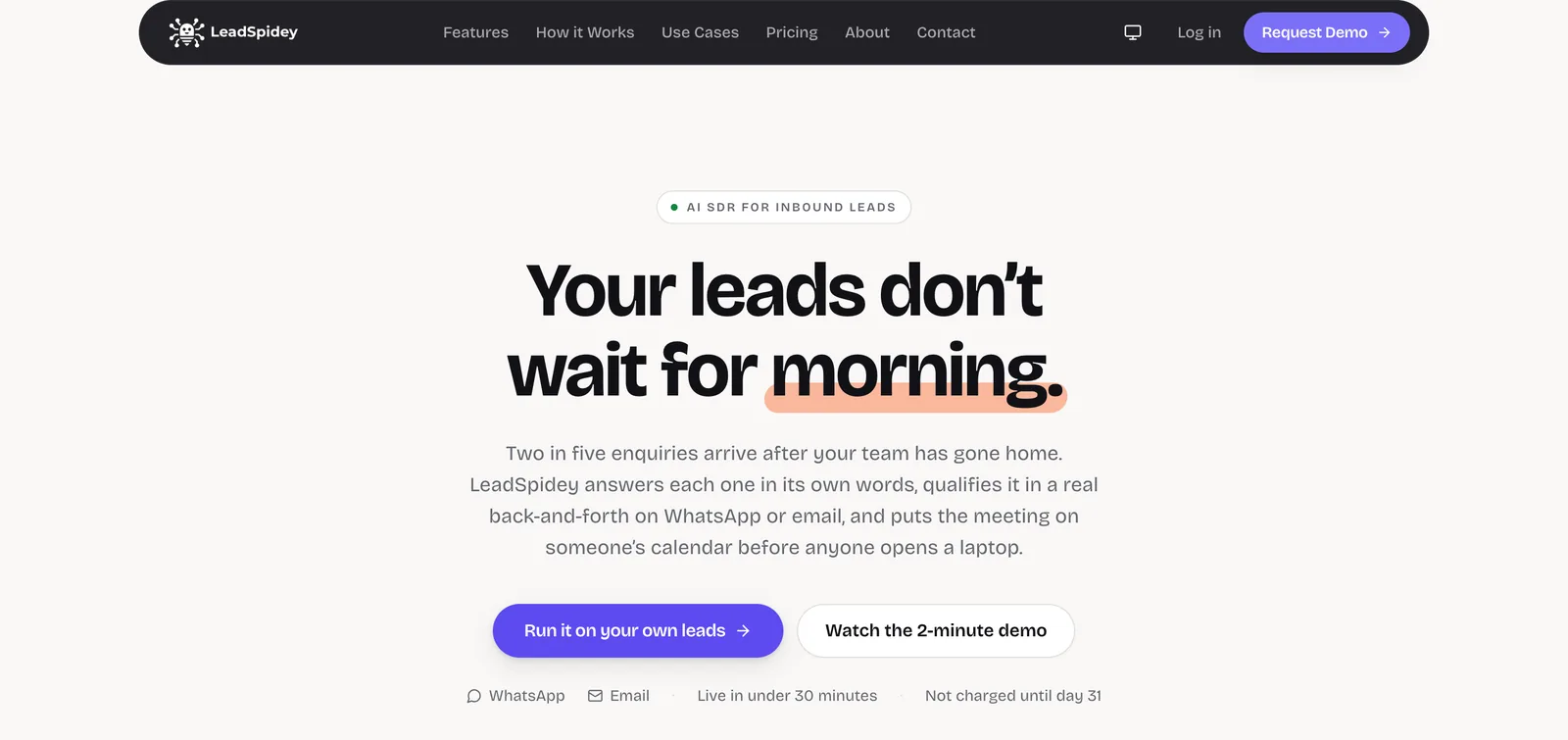
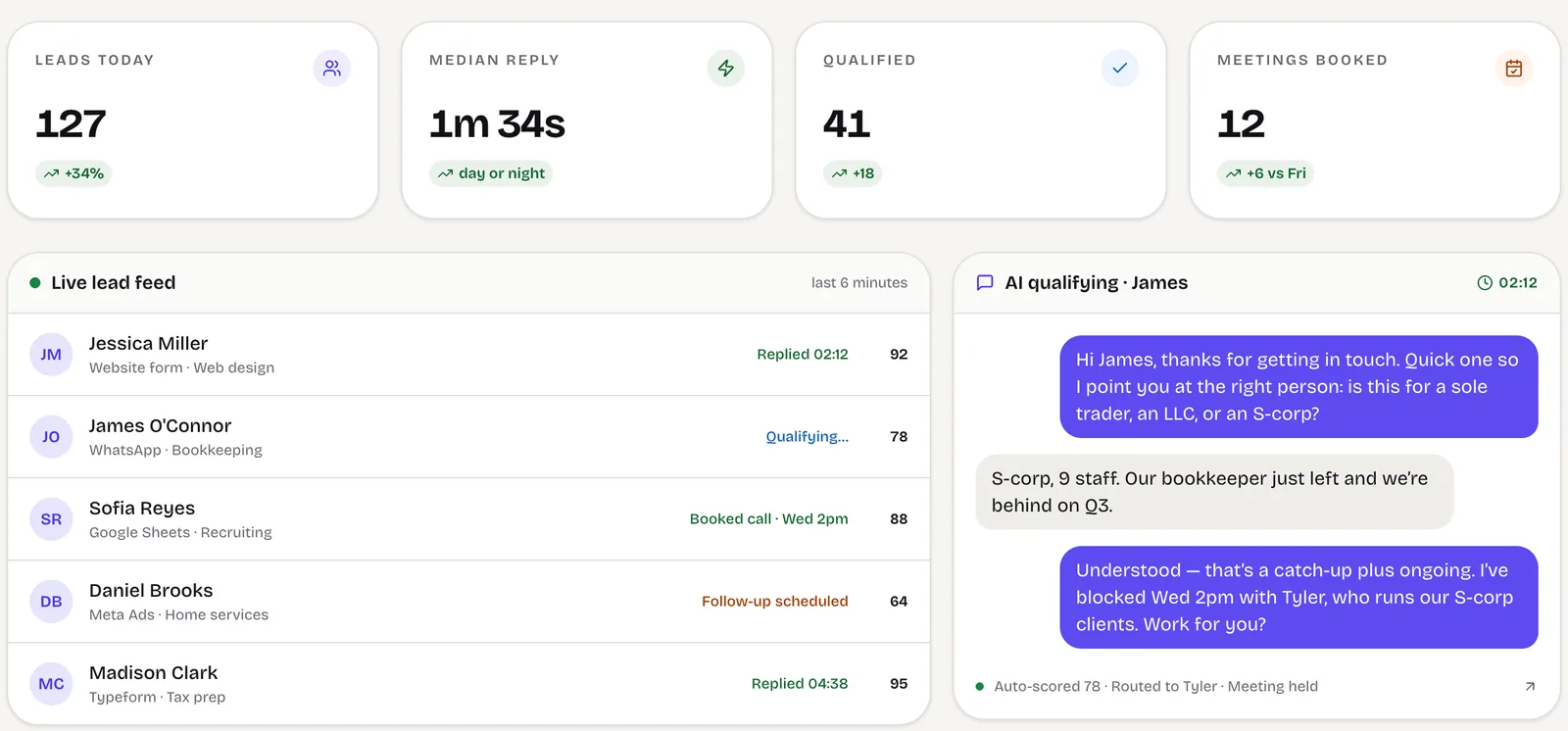
LeadSpidey · AI SDR for inbound leads
An AI SDR that answers inbound leads on WhatsApp and email, qualifies them in conversation and books meetings, at any hour.
About LeadSpidey -

Prosvano · LinkedIn automation
An always-on lead agent that proposes segments, finds people and drafts outreach, with nothing sent before a person approves it.
About Prosvano
10 Build, buy or configure
An honest comparison.
Sometimes software you can buy is the right answer, and we will say so. This is how we weigh it.
| What matters | Off-the-shelf SaaS | Low-code builder | Scribbify build |
|---|---|---|---|
| Fits how your team actually works | Partly: You adapt to its fields | Partly: Until the rules get complex | Yes: Built around how you work |
| You own the code and the data | No: Rented | Partly: Locked to the platform | Yes: Yours, documented |
| Joins every tool you already use | Partly: Where integrations exist | Partly: Simple connections | Yes: Any API or export |
| Cost stays flat as you hire | No: Priced per seat | No: Priced per seat | Yes: No per-seat licence |
| AI agents with approvals built in | Partly: Generic assistants | Partly: Add-ons | Yes: Built for your rules |
| Someone accountable for the outcome | No: A support ticket | No: Your own team | Yes: Measured with you |
11 Questions
Before you write.
Other services
What is an AI agent, in practical terms?
How do you stop an agent from getting things wrong?
Which AI models do you use?
Is our data used to train AI models?
Can we start small?
Do you build on n8n, Make or Zapier?
Start a project
Talk to us about AI agents.
Tell us where the work or the revenue gets stuck: the job, the tools it runs on and what it costs you. We will tell you plainly whether building is worth it.
- A partner reads every enquiry
- A 45-minute working call
- A written scope you can decide on
Or write to us at [email protected]
All services